
Payout Schemes Compared: Steady Credits or a Wider Swing
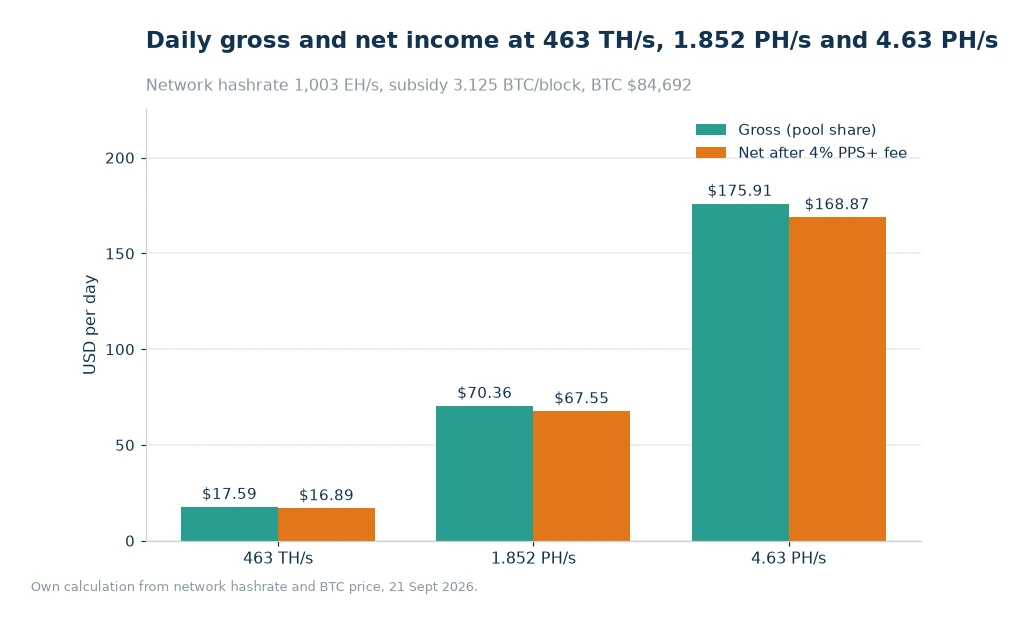
Two miners with identical hardware can earn the same coins and still see very different balances each week. The scheme decides who carries the variance. At 463 TH/s the daily gross is 0.0002077 BTC, or $17.59, and the net after the listed 4% is $16.89 — but the path to that average depends on the choice made at signup.

Key takeaways
- 463 TH/s produces 0.0002077 BTC a day, worth $17.59 gross and $16.89 net at the listed 4%.
- PPS+ settles hourly on current difficulty, so pool luck stays on the pool's side of the ledger.
- PPLNS pays after six confirmations and spreads your share across the last five difficulty rounds.
- The blended fee is not 6%: 4% sits on the block reward, 2% on the transaction-fee component.
Who carries the variance
A pool finds blocks at random intervals even when its hashrate is constant. Someone has to absorb that randomness. Under PPS+ it is the pool: the block-reward component is settled per share at a fixed rate against current difficulty, and the miner's credit arrives hourly whether the pool found four blocks that hour or none. Under PPLNS it is the miner: payment waits for a block to reach six confirmations, and the size of the payment depends on how many shares you contributed inside the last five difficulty rounds.
That single difference explains the fee gap. PPS+ lists 4% on the block-reward component precisely because the pool is taking on timing risk, and 2% on the transaction-fee component, which is distributed on PPLNS logic. PPLNS lists 2% on the combined block reward and fees because the miner is carrying the timing. Neither rate is a discount or a penalty; they price different arrangements.
For a miner with a fixed electricity bill, the distinction is practical. PPS+ delivers a credit every hour, which makes a monthly budget easy to build and a shortfall easy to spot. PPLNS delivers larger, lumpier credits, and a quiet fortnight in the middle of a billing cycle is normal rather than alarming. The long-run average under PPLNS is usually a little higher, but the sequence is not smooth.
What the listed rates cover
The 4% and 2% figures apply to different buckets, which is why anyone quoting a single 6% charge has misunderstood the schedule. Picture a day's income split into block reward and transaction fees. Under PPS+, the block-reward bucket pays 4% and the fee bucket pays 2%. Since the block reward is the overwhelming majority of income at current fee levels, the blended charge lands just under 4% of the total. A fee-heavy day nudges it down a little further.
Under PPLNS the two buckets are pooled and charged 2% once. That looks cheaper on paper and often is, in exchange for the timing risk described above. The comparison only becomes fair when both schemes are measured over the same period and the same hashrate, because a single block's fee load can move one day's result by more than the rate difference.
| Hashrate | Gross USD | Listed 4% | Net USD | Net BTC |
|---|---|---|---|---|
| 463 TH/s | $17.59 | $0.70 | $16.89 | 0.00019939 |
| 1.852 PH/s | $70.36 | $2.81 | $67.55 | 0.00079758 |
| 4.63 PH/s | $175.91 | $7.04 | $168.87 | 0.00199397 |
Read the deduction column as a scale check, not as a bill. At 463 TH/s it is 70 cents a day, roughly the cost of a kilowatt-hour or two depending on where you live. At 4.63 PH/s it is $7.04, which is real money but still a small fraction of the gross. The fee is not the variable that decides whether a farm is viable; power and hardware are.
Worked example
- Emission first: 144 blocks at 3.125 BTC gives 450 BTC.
- A single TH/s is worth 450 ÷ 1,003,000,000, or 0.0000004486 BTC.
- 463 TH/s: 463 × 0.0000004486 = 0.0002077 BTC a day.
- At $84,692: 0.0002077 × 84,692 = $17.59.
- Listed 4% on the block-reward component: 17.59 × 0.04 = $0.70.
- Net: 17.59 − 0.70 = $16.89, which is also 17.59 × 0.96.
- 1.852 PH/s is 1,852 TH/s: 1,852 × 0.0000004486 = 0.00083081 BTC, or $70.36 gross and $67.55 net.
- 4.63 PH/s is 4,630 TH/s: 4,630 × 0.0000004486 = 0.00207705 BTC, or $175.91 gross and $168.87 net.
Variance hurts most when the bills are monthly
A mining operation has two cost profiles. Power, rent and hosting fees arrive on a schedule with very little variation. Income under PPLNS does not. A month with a few dry spells can produce a total well below the arithmetic while the invoices stay exactly where they were, and the shortfall has to be covered from somewhere. That mismatch, not the average, is what forces some operators toward PPS+ even when they expect PPLNS to pay slightly more over a year.
The tolerance for lumps depends on scale. A container operation with 4.63 PH/s sees daily swings in dollar terms that would frighten a single-machine miner, yet the same percentage swing matters less because the operator holds a cash buffer. A home miner at 463 TH/s with a tight margin feels every quiet day. Matching the scheme to the buffer is a more useful exercise than arguing about which scheme is better in the abstract.
Switching schemes later
Most accounts let you change the scheme, and the change applies to future settlement rather than to credits already earned. Anything pending under PPLNS still follows the old rules, including the confirmation wait. If you switch during a dry spell, expect the first PPS+ credits to overlap with a PPLNS payment that may still arrive later, which can make a single day look unusually large.
The ViaBTC Mining Guide sets out the mechanics for each coin and scheme, including the hourly cycle and the five-round window. Read the relevant page before switching rather than after, because the window is the part people misremember: it is measured in difficulty rounds, not in hours, so its wall-clock length changes with the network.
A way to test the choice
Run one scheme for a full month and keep the daily credits in a single column. Then run the other for a month at the same hashrate. Two months is a short sample and the comparison will still be noisy, but it will be your noise rather than someone else's anecdote. If the totals are close, choose the one whose timing matches your bills. If one is clearly ahead, check whether difficulty or price moved between the two months before crediting the scheme.
Use the Profit Calculator to convert each month's hashrate into a predicted gross, then compare that with what arrived. The gap between prediction and credit is the honest measure of how much variance you actually experienced, and it is the number that should decide whether the lumpier scheme is tolerable.
Frequently asked questions
Is PPS+ the steadier option?
It is steadier, because the block-reward component settles hourly on current difficulty and the pool carries the timing. Whether that steadiness is worth the listed 4% depends on how much a quiet week would strain your cash flow.
Does PPLNS really pay more over time?
Its long-run average is usually a little higher because the listed rate is 2% on the combined components, but any given month can land well above or below that average. The sequence is the trade-off, not the expected value.
Can I run both schemes on one account?
Usually the scheme is set per coin account or per worker group rather than per machine, so splitting is limited. Check the setting before you plan around two parallel payout styles.
Decide by your cash buffer, not by the fee table
Write down the monthly cost of running your hardware, then write down the worst month the scheme could plausibly deliver. If the buffer covers the gap, the lumpier option is available to you. If it does not, the steadier one is worth its listed rate. The fee page has the exact components, and the arithmetic above shows how little they move the daily total compared with power and price.
Sources: ViaBTC's homepage and pricing pages, for scheme mechanics and the listed 4% and 2% rates[1]. The chain data behind every figure was read on 21 Sept 2026 (network 1,003 EH/s; difficulty 132.76 T; 3.125 BTC per block, 144 blocks a day; BTC $84,692). Uptime is assumed continuous. Published 22 Oct 2026.